Home Workouts
A Resistance Band Workout You Can Do Anywhere
A beginner-friendly full-body resistance band workout you can do at home, in a hotel room, or outside — no gym required.
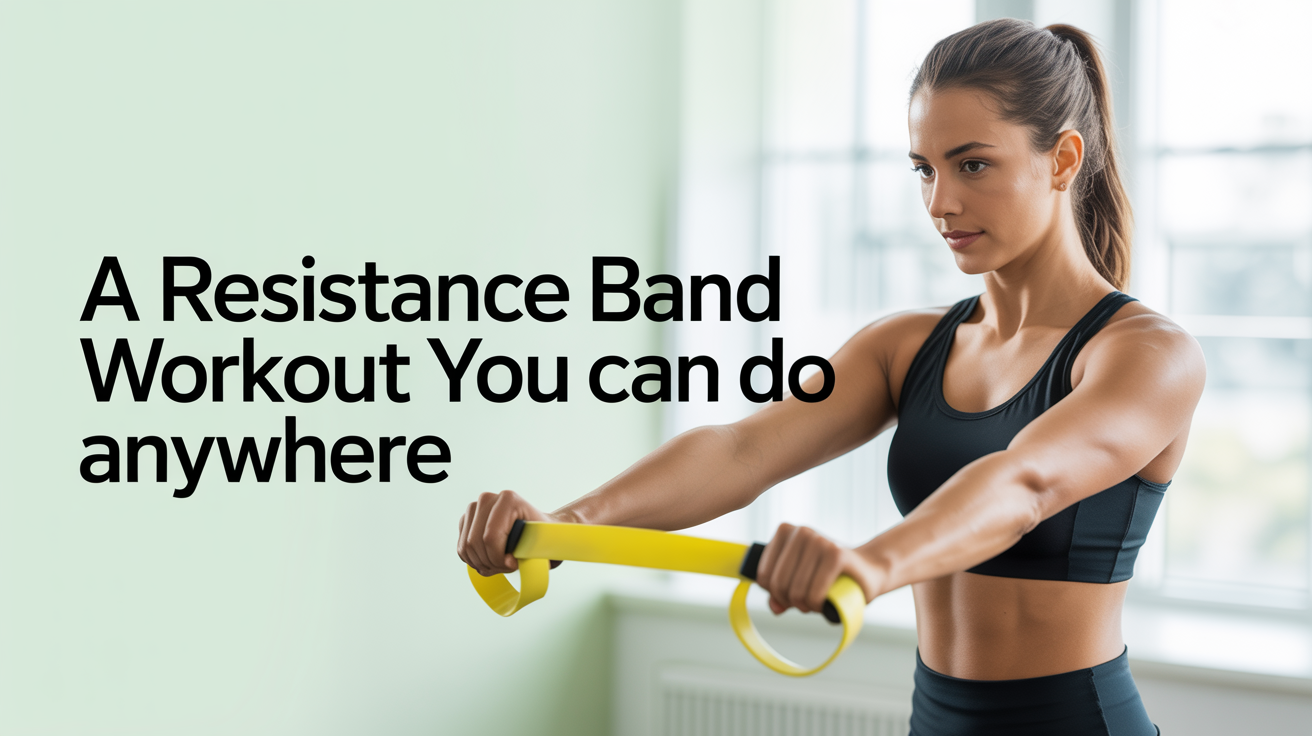
A single loop or tube band weighing less than half a pound gives you enough resistance to train every major muscle group. You don't need a rack, a bench, or a gym membership. This guide walks you through a complete beginner routine, how to set it up, and how to keep making progress as you get stronger.
What You Need Before You Start
One band. A flat loop band (the wide "power" style) or a tube band with handles both work for this routine. For most beginners, a light-to-medium resistance level is the right starting point, you want to complete the prescribed reps with a little effort on the last two or three.
Check the band first. Run your fingers along the entire length before each session. Nicks, tears, or discoloration are signs the band is weakening. A snapping band can cause a real injury. If you see damage, replace it.
A door anchor (optional but useful). Several exercises below use the band anchored at chest or floor height. A simple door anchor strap (most tube band sets include one) lets you do rows and chest presses without needing a post or railing.
Warm-up (5 minutes). Do 10 arm circles each direction, 10 leg swings per side, 15 bodyweight squats, and 10 cat-cow stretches. Cold muscles are more prone to strain, and a band pulling against a cold shoulder is a shortcut to irritation.
The Full-Body Band Workout
Do this routine two or three times per week with at least one rest day between sessions. Each session should take 30 to 40 minutes including rest periods.
| Exercise | Sets x Reps | Setup / Key Cue |
|---|---|---|
| Band Squat | 3 x 12 | Stand on band, hold handles at shoulders. Keep chest up, knees tracking over toes. |
| Band Romanian Deadlift | 3 x 10 | Stand on band, hold handles in front of thighs. Hinge at hips, slight knee bend, flat back. |
| Band Chest Press | 3 x 12 | Anchor band at mid-back height in a door. Hold handles, press forward at chest level. |
| Band Row | 3 x 12 | Anchor band at chest height. Pull handles to sides of ribs, elbows back, squeeze shoulder blades. |
| Band Overhead Press | 3 x 10 | Stand on band, hold handles at shoulders. Press straight overhead, lock out elbows at top. |
| Band Pull-Apart | 3 x 15 | Hold band in front of chest, arms straight. Pull both ends apart until band touches chest. |
Rest 60 to 90 seconds between sets.
Exercise-by-Exercise Breakdown
Band Squat
Step both feet onto the middle of the band, shoulder-width apart. Hold the handles (or the band itself if you're using a loop) at shoulder height, elbows pointing forward. Sit back and down as if into a chair, keeping your weight in your heels and your chest tall. Drive through your heels to stand back up.
To make it harder: shorten the band by stepping your feet wider or choking up on the handles, or slow the descent to a 3-second count.
Band Romanian Deadlift
Stand on the band with feet hip-width apart. Hold both handles (or ends) in front of your thighs with a slight bend in the knees. Push your hips back, not down, while keeping your back flat and the band close to your legs. Lower until you feel a pull in your hamstrings, then drive your hips forward to return to standing. This is a hinge, not a squat; your knees barely move.
Band Chest Press
Thread the band through a door anchor set at mid-back height, or loop it around a sturdy post at that level. Face away from the anchor. Hold one handle in each hand at chest height, elbows bent at 90 degrees. Step forward to create tension, then press both hands forward until your arms are straight. Bring them back slowly.
No door anchor? Lie on the floor, loop the band under your upper back, and press from there.
Band Row
Anchor the band at chest height and face the anchor point. Hold a handle in each hand, arms straight in front of you. Step back until the band is taut. Pull both handles to the sides of your ribcage, driving your elbows behind you and squeezing your shoulder blades together at the end. Return slowly. Keep your torso still throughout.
Band Overhead Press
Stand on the band with feet shoulder-width apart. Hold both handles at shoulder height, palms facing forward. Press straight up until your arms are fully extended, then lower back to the start. Avoid arching your lower back, brace your core as if you're about to take a punch.
Band Pull-Apart
Hold the band in both hands with arms extended straight in front of you at shoulder height. Keep your arms straight and pull both ends apart, moving your hands out to your sides until the band touches your chest. Squeeze your shoulder blades, pause for one second, then bring your hands back together under control. This one looks easy but fatigues the rear delts and upper back fast, which is exactly the point for people who sit at a desk all day.
How to Progress Without Buying New Bands
The most common mistake beginners make is grabbing a thicker band too early. You can get months of progression from a single band by adjusting tension and tempo.
Shorten the band. The closer your hands are to the anchor point (or the more the band is doubled up underfoot), the more resistance you feel at every point in the rep. For squats and deadlifts, try a narrower stance or wrap the band once around your hand.
Slow the lowering phase. A 3-second descent doubles the time your muscles are under load. It also catches form breakdowns you might power through at normal speed.
Add a pause at the hardest point. Pausing at the bottom of a squat or at the peak of a row removes momentum from the movement. Your muscles have to do all the work.
Add reps before adding resistance. Once you can complete all sets with good form and the last rep feels easy, add 2 reps per set. When you reach 15 reps comfortably, move to a thicker band or shorten the current one further.
Why Bands Work Well for Travel
A full set of loop bands rolls up smaller than a pair of socks. There's no liquid restriction, no weight limit, and no checked bag required. Loop them over a hotel shower bar, a fence post, or the leg of a heavy piece of furniture and you have an anchor. The workout above can run in a 6-by-6-foot space, which covers virtually any hotel room.
Bands also travel better than dumbbells for joint stress. The resistance increases as you stretch the band, so the heaviest load hits at full extension rather than at the joint's most vulnerable angle (as it does with a free weight at the bottom of a curl). That's genuinely useful for people who are training through minor stiffness or easing back in after time off.
If you want to pair bands with bodyweight work on travel days, A Full Bodyweight Workout for Beginners (No Equipment) covers a companion routine that needs nothing but floor space. For a longer-term home training plan that adds dumbbells once you're ready to invest in a bit more equipment, see How to Build Muscle at Home with Minimal Equipment.
Safety Notes Worth Reading
Stop if you feel sharp, pinching, or joint pain. Muscle burn and effort are normal; joint pain is not. Bands are generally lower-impact than free weights, but they are not zero-risk, especially when anchoring around your back or shoulders. A band that snaps under tension can cut skin or hit your face, always check the band, never let go of a stretched band abruptly, and keep your face clear of the line of pull.
If you're new to hinge movements (the Romanian deadlift in particular), start with no band at all. Nail the hip-hinge pattern with bodyweight before adding load.
Frequently Asked Questions
Can resistance bands actually build muscle, or are they just for rehab?
Bands build muscle through the same mechanism as any other resistance: they force your muscles to work against load, and if the load is challenging enough to cause fatigue by the last few reps, the muscle adapts and grows. Research has found resistance bands produce comparable hypertrophy to free weights at matched training volumes. The limitation is that bands top out at a fixed maximum tension, but for most beginners, that ceiling is far higher than what they'll reach in the first several months.
How do I know what resistance level to start with?
A practical test: if you can complete 15 reps of a banded squat without your form breaking down and the last rep feels easy, the band is too light. If you can't complete 8 reps with good form, it's too heavy. Land somewhere in between. Most people starting out do well with a light or medium band (often labeled 10–30 lbs or in a color like yellow or green, depending on the brand).
How many days a week should I do this workout?
Two to three times per week is appropriate for beginners. Your muscles need 48 hours to recover between sessions. Doing the same workout every day without rest will slow your progress and increase your injury risk, not speed things up.
Do I need to combine this with cardio?
Not for the purpose of building strength. Cardio and strength training serve different goals and both have real health benefits. If you're short on time, focus on consistent strength sessions first and add cardio when it fits. If you already enjoy running or cycling, there's no reason to stop, just schedule them so you're not doing a hard cardio session right before a strength session, which would blunt your performance.
What if I only have one band and the exercises feel uneven in difficulty?
That's normal. Pull-aparts and rows tend to feel easy on the same band that makes squats and deadlifts genuinely hard. Adjust per exercise: shorten the band more for pressing and pulling movements, and use full length for lower body. Over time you may want two bands in different resistances, light for upper body accessories and medium-heavy for lower body work. For more on building out a minimal home setup, The Best Dumbbell Workout for Beginners explains how adding a single pair of dumbbells opens up a different range of movements once you've outgrown band-only training.