Home Workouts
A Full Bodyweight Workout for Beginners (No Equipment)
A complete bodyweight workout for beginners: warm-up, full routine with sets and reps, easier variations, and a clear path to progress. No equipment needed.
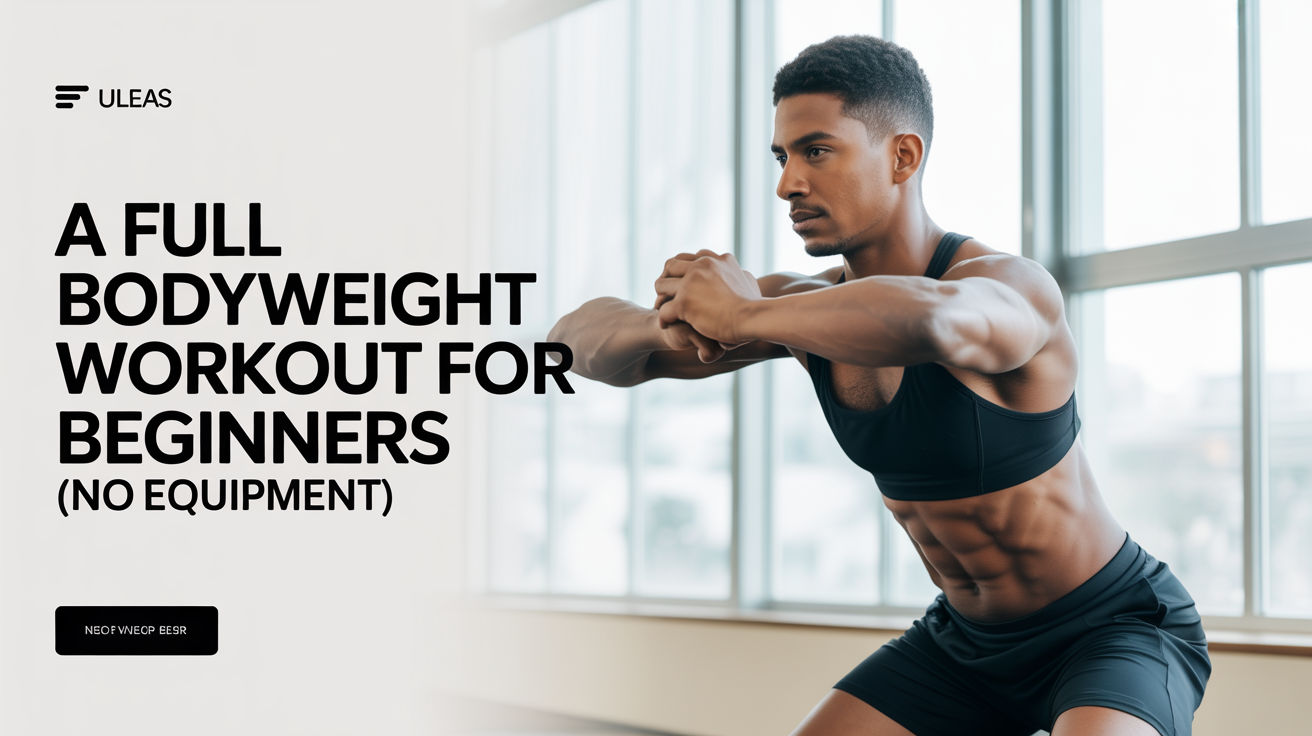
You don't need a gym membership or a single piece of gear to start building real strength. This routine uses your own bodyweight to work every major muscle group, fits in about 30 minutes, and is designed for people who are brand new to structured exercise.
Before starting any new fitness program, check with your doctor if you have any existing injuries, joint problems, or health conditions. Stop immediately if you feel sharp or shooting pain (mild muscle burn is normal; sharp pain is not).
Why Bodyweight Training Works for Beginners
Most beginners are stronger than they think, and weaker in certain patterns than they realize. Bodyweight training forces you to move through full ranges of motion, teaches you how to control your body, and builds a foundation that carries over to everything else, including weights and sports.
The compound movements in this routine (squats, lunges, push-ups, bridges) recruit multiple muscle groups at once. That means more training effect per minute and better coordination between muscles that need to work together.
There's also a practical reason: removing the barrier of equipment means you'll actually do it. Consistency over six weeks beats a perfect program you abandon after three sessions.
Warm-Up (5 Minutes)
Skipping the warm-up is one of the most common beginner mistakes. Cold muscles are less pliable and more prone to strain. Five minutes is all you need.
The Warm-Up Sequence
Move through each of these for about 45 to 60 seconds, at an easy pace:
- Arm circles (forward and backward), loosens the shoulder capsule
- Hip circles, stand with feet shoulder-width apart, hands on hips, draw slow circles
- Leg swings, hold a wall for balance, swing each leg forward and back 10 times
- Bodyweight good mornings, hands behind head, hinge at the hips until you feel a light hamstring stretch, stand back up; slow and controlled
- Jumping jacks or marching in place, gets the heart rate up slightly and warms the calves
By the end you should feel slightly warmer, not fatigued.
The Workout
Do this routine two to three times per week, with at least one rest day between sessions. Three sessions per week is a solid starting target.
For each exercise, rest 60 to 90 seconds between sets. If 90 seconds isn't enough, take more. Rest is not laziness; it's part of the training stimulus.
Full Routine at a Glance
| Exercise | Sets x Reps | Easier Variation |
|---|---|---|
| Bodyweight squat | 3 x 10 | Sit-to-stand from a chair |
| Incline or knee push-up | 3 x 8–10 | Wall push-up |
| Glute bridge | 3 x 12 | Reduce range of motion |
| Reverse lunge | 3 x 8 per side | Assisted lunge (hold a wall) |
| Dead bug | 3 x 6 per side | Bent-knee hold only |
| Inverted row (table) | 3 x 8 | Feet closer to table (less horizontal) |
Exercise Instructions
Bodyweight squat. Stand with feet shoulder-width apart, toes turned out slightly. Push your hips back like you're sitting into a chair, keep your chest up, and lower until your thighs are roughly parallel to the floor (or as low as feels comfortable). Push through your heels to stand. Don't let your knees cave inward.
Easier: Sit-to-stand from a sturdy chair. Lower yourself slowly onto the chair and stand back up. Same movement, just with a shorter range. Harder: Pause for two seconds at the bottom before standing.
Incline or knee push-up. For an incline push-up, place your hands on a counter, sturdy table, or the bottom stair. The higher the surface, the easier it is. Keep your body in a straight line from head to heels and lower your chest toward the surface. For a knee push-up, the same rules apply but your knees stay on the floor.
Easier: Wall push-up. Stand arm's length from a wall, place hands flat, and do the same motion. Harder: Floor push-up with full body in a plank position.
Glute bridge. Lie on your back, knees bent, feet flat on the floor about hip-width apart. Press your feet into the floor and lift your hips until your body forms a straight line from knees to shoulders. Squeeze your glutes at the top for one second, then lower slowly. This targets the glutes and hamstrings and is gentle on the lower back.
Easier: Lift your hips only partway and focus on the squeeze. Harder: Hold for three seconds at the top, or do a single-leg bridge.
Reverse lunge. Stand tall, step one foot back, and lower your back knee toward the floor. Your front knee should stay above your ankle, not shooting past your toes. Push through your front heel to return to standing. Repeat on the other side.
Easier: Hold a door frame or wall for balance. Harder: Add a small forward lean of the torso, which increases glute demand.
Dead bug. Lie on your back, arms extended straight toward the ceiling, knees bent at 90 degrees (legs lifted so shins are parallel to the floor). Press your lower back firmly into the floor, that's your anchor point. Slowly lower your right arm behind your head while simultaneously extending your left leg toward the floor. Return to start, then switch sides. The goal is controlled movement without your lower back arching up.
Easier: Keep both knees bent and just lower one arm at a time, keeping legs still. Harder: Move more slowly (3–4 seconds down, 2 seconds return).
Inverted row (table row). This is your pulling movement. Lie under a sturdy table, grip the edge with both hands (overhand or underhand), and extend your legs out. Your body should form a plank. Pull your chest up to the table edge, then lower yourself slowly. This works your upper back and biceps, muscles often neglected in beginner routines.
Easier: Bend your knees and place feet flat on the floor, reducing the amount of bodyweight you're pulling. Harder: Elevate your feet on a chair.
If you don't have a table that works, substitute a doorframe row: stand in a doorway, grip both sides at about hip height, lean back until your arms are nearly straight, then row yourself forward. Not identical, but it addresses the same pulling pattern.
How to Progress
The biggest mistake beginners make is staying at the same difficulty indefinitely. Your body adapts, which is good, but it means you need to keep nudging the challenge upward.
The Two-Rep Rule
Once you can complete all sets of an exercise with clean form and two reps left in the tank (you could have done more), it's time to add reps or move to a harder variation. Use this order:
- Add one rep per set until you reach the top of the rep range
- Then move to a harder variation and start back at the lower end of the rep range
- Or reduce rest time from 90 seconds to 60 seconds
For example: when knee push-ups feel easy for 3 x 10, try incline push-ups at 3 x 6. Build back up to 3 x 10, then try a full floor push-up.
When to Move to Equipment
After six to eight weeks of consistent training, you'll likely notice that pure bodyweight movements are getting too easy on some exercises. Squats in particular become limited by balance and rep count rather than strength. That's a natural point to add load. A pair of light dumbbells or a resistance band opens up a lot of options without requiring a gym.
For a natural next step, see how to build muscle at home with minimal equipment or the best dumbbell workout for beginners. If you want to stay equipment-free but add variety, a resistance band workout you can do anywhere is worth a look once you have a single band.
Cool-Down and Recovery
Five minutes at the end matters more than most beginners expect. Your nervous system is still somewhat activated after training, and a brief cool-down helps bring heart rate down and reduces the chance of next-day stiffness becoming a deterrent.
Simple Cool-Down Sequence
Hold each stretch for 20 to 30 seconds per side:
- Standing quad stretch, stand on one foot, pull the other heel toward your glute
- Hip flexor stretch, drop into a half-kneeling lunge position, push the hips forward slightly
- Chest stretch, clasp hands behind your back, squeeze shoulder blades, lift arms slightly
- Child's pose, kneel and reach arms forward on the floor, sit hips back toward heels
Drink water, eat a protein-containing meal or snack within a couple of hours, and get adequate sleep. These aren't optional extras; they're where adaptation actually happens.
Frequently Asked Questions
How many times a week should I do this workout?
Two to three times per week is the right range for most beginners. More than three sessions per week doesn't give your muscles enough time to recover and adapt, especially in the first month when your body is still learning the movement patterns. Three days on, four days off (or alternating days) both work well.
Will bodyweight training actually build muscle?
Yes, particularly in the first several months. Muscle growth responds to mechanical tension and progressive overload, making exercises harder over time. Bodyweight training provides both, as long as you keep progressing (more reps, harder variations, slower tempo). At a certain point you'll need external load to keep building, but beginners have a long runway before hitting that ceiling.
What if I can't do a single push-up?
Start with wall push-ups. They use the same movement pattern with far less load (you're pushing maybe 20 to 30 percent of your bodyweight instead of 60 to 70 percent). Build to 3 x 15 wall push-ups, then move to incline push-ups on a higher surface. Lower the surface incrementally over weeks. Most people reach a floor push-up within four to eight weeks using this approach.
How sore will I be after the first session?
Expect some soreness 24 to 48 hours after your first two or three sessions. This is called delayed onset muscle soreness (DOMS) and is a normal response to unaccustomed exercise. It's not a reliable indicator of a good workout, and it diminishes significantly after the first couple of weeks as your body adapts. Mild soreness is fine to train through. Significant pain or soreness that worsens after a few weeks is a reason to rest and, if it persists, to see a healthcare provider.
Can I do this workout if I'm overweight?
Yes, with some modifications. Wall and incline push-ups are genuinely better starting points than floor push-ups for most people regardless of body size, because they reduce the load your joints need to handle while you build strength. The chair-assisted squat and assisted lunge are also helpful. The priority is finding a variation of each exercise where you can move through the full range of motion with control. Consult your doctor before starting if you have any joint, cardiovascular, or metabolic concerns.