Home Workouts
A 20-Minute Home Workout for Busy Beginners
A no-equipment 20-minute home workout for beginners. Clear structure, safe form cues, and full-body moves you can do in any small space.
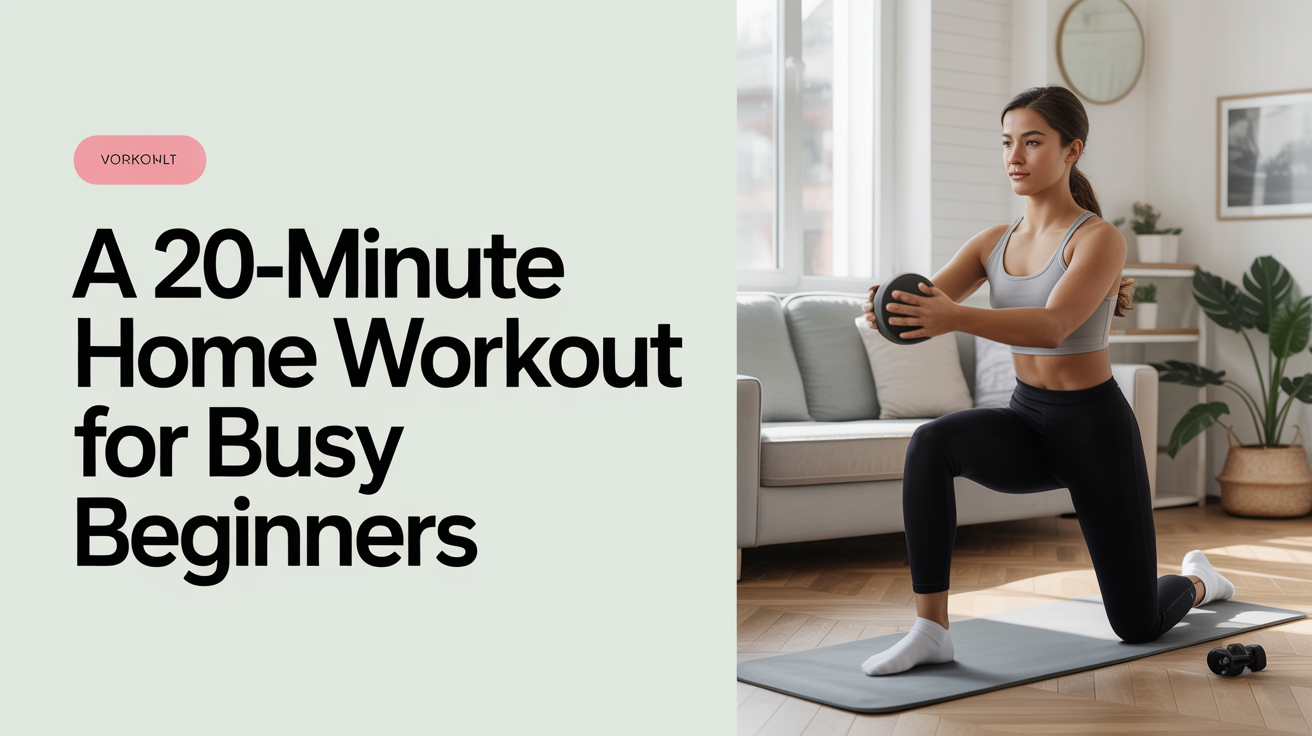
Twenty minutes is enough. Not as a motivational slogan, but as a practical fact: a short workout done consistently beats a long one done occasionally. If you are new to training and short on time, a 20-minute full-body routine gives you a genuine stimulus for building strength and fitness without requiring a gym, equipment, or a large block of free time.
This guide walks you through a beginner-friendly routine you can do in your living room, with clear instructions for each exercise and safety cues so you start the right way. As with any new exercise program, check with your doctor before beginning, especially if you have an injury, a medical condition, or have been sedentary for a long period. Stop immediately if you feel sharp pain, dizziness, or chest discomfort, and seek qualified help.
At a Glance
- Three parts: a 3 to 4 minute warm-up, 13 to 15 minutes of working sets, and a 2 to 3 minute cooldown.
- Six exercises cover the main patterns: squat, hinge, push, pull, core, and a step or lunge.
- Rest 45 to 60 seconds between exercises; take more if you need it.
- Do the routine two to three times per week with a rest day between sessions, which comfortably clears the national guideline of muscle-strengthening activity on at least 2 days a week.
- Progress by adding reps, slowing the lowering phase, or moving to a harder variation, not by adding more exercises.
- No equipment required; a mat, a sturdy table, and a doorway cover everything on this list.
Why 20 Minutes Is a Solid Starting Point
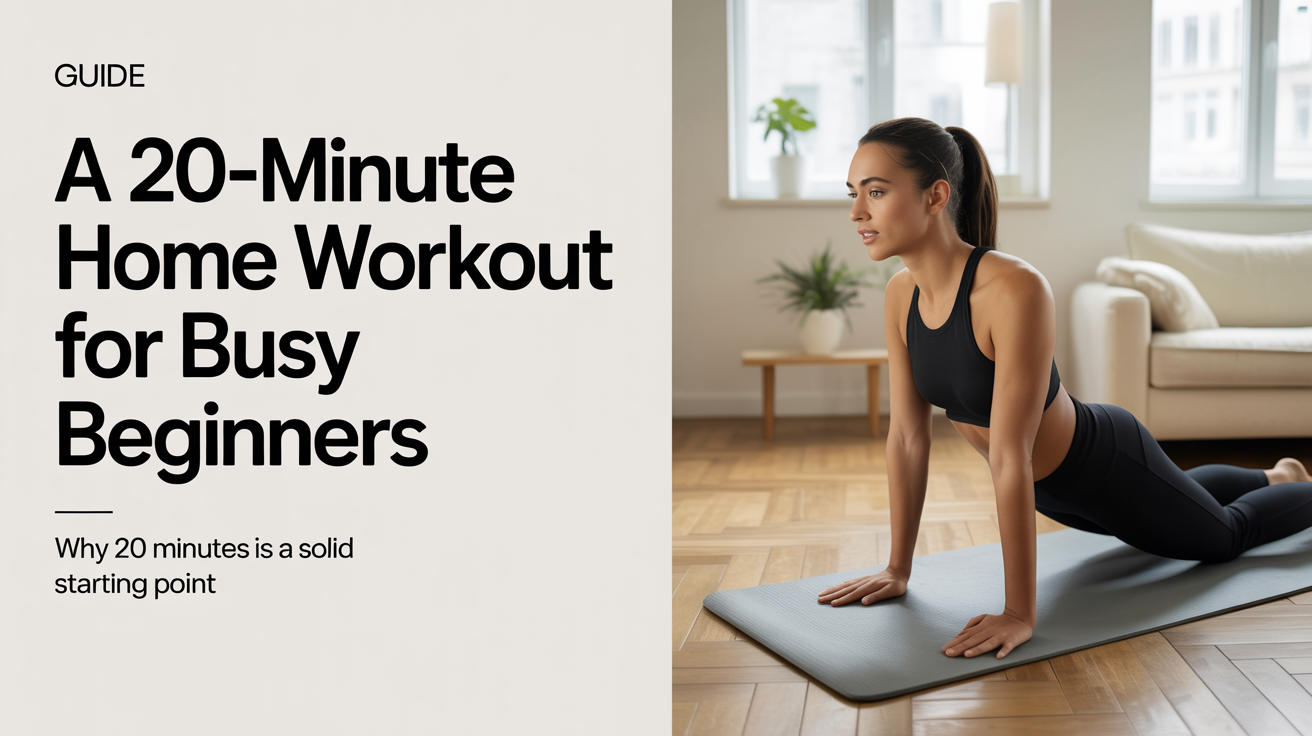
A common worry for beginners is that a short workout will not do anything useful. That concern makes sense if you picture long gym sessions as the only valid format, but the research on training volume tells a different story. For someone new to structured exercise, even two or three working sets of a movement per session is enough to trigger adaptation. Your nervous system and muscles respond to a new challenge, not to a specific number of minutes.
The bigger risk for beginners is doing too much too soon. Long, intense sessions in the first weeks often lead to soreness that derails the next workout, or minor injuries that derail the whole program. A 20-minute session is long enough to cover the major movement patterns but short enough that you can recover well and show up again in two days. Twenty minutes, three times a week, is 60 minutes of structured training weekly, which already clears the national guideline of strengthening every major muscle group on at least 2 days a week, with a session to spare.
Once you can complete this routine comfortably and want more volume, you can either extend it or look at what a full bodyweight workout for beginners looks like at a slightly longer duration.
How the Workout Is Structured
The session has three parts.
Warm-up (3 to 4 minutes). Never skip this. A brief warm-up raises your core temperature, lubricates your joints, and primes your nervous system for the work ahead. Cold muscles and connective tissue are more prone to strains, and rushing intensity before your body is ready is one of the more consistently cited risk factors for exercise-related injury.
Working sets (13 to 15 minutes). Six exercises covering the main movement patterns: a squat, a hinge, a push, a pull, a core hold, and a step or lunge pattern. You will do each exercise for a set amount of reps or time, rest briefly, and move to the next.
Cooldown (2 to 3 minutes). Light stretching for the muscles you just used. This is not the time to chase a deep passive stretch; gentle holds of 20 to 30 seconds per position are sufficient.
The 20-Minute Routine
Complete the warm-up, then move through the six exercises in order. Rest 45 to 60 seconds between exercises. If you need more rest, take it. Moving safely matters more than keeping a strict pace.
Warm-up (3 to 4 minutes)
- Arm circles: 10 forward, 10 backward
- Hip circles: 10 each direction
- Leg swings: 10 per leg, front-to-back, then side-to-side
- Slow bodyweight squats with a 3-second descent: 8 reps
- Cat-cow on hands and knees: 8 slow cycles
Working sets
| Exercise | Reps or Time | Rest |
|---|---|---|
| Bodyweight squat | 3 sets x 10 reps | 45 sec |
| Hip hinge (Romanian deadlift without weight) | 3 sets x 10 reps | 45 sec |
| Incline or floor push-up | 3 sets x 8-10 reps | 45 sec |
| Inverted row (under a table) or door-frame row | 3 sets x 8 reps | 45 sec |
| Dead bug | 3 sets x 6 reps per side | 45 sec |
| Reverse lunge | 2 sets x 8 reps per leg | 45 sec |
Cooldown (2 to 3 minutes)
- Hip flexor stretch (kneeling): 20 seconds per side
- Doorway chest stretch: 20 seconds
- Child's pose: 30 seconds
Form Cues for Each Exercise
Good form protects you from injury and makes the exercise more effective. Here are the key points for each movement.
Bodyweight squat. Stand with feet about shoulder-width apart. Push your hips back and down as if sitting toward a low chair. Keep your chest up and your knees tracking in line with your toes. Stop when your thighs are roughly parallel to the floor, or at whatever depth you can reach without your lower back rounding. Press through your whole foot to stand.
Hip hinge. Stand with feet hip-width apart. Soften your knees slightly, then push your hips straight back while keeping your back flat and your gaze down. You will feel a stretch through your hamstrings. Return by driving your hips forward, not by pulling with your lower back. This pattern is the foundation of the deadlift; learning it well matters. If you want to add load later, see our guide to building muscle at home with minimal equipment for how to progress the hinge with dumbbells.
Push-up. Use an incline (hands on a counter, a desk, or a wall) if a full floor push-up is too demanding right now. A well-executed incline push-up is far better than a sloppy floor push-up where your hips sag. Keep your body in a straight line from head to heels. Lower your chest to the surface, not your chin or hips.
Inverted row. Lie under a sturdy table, grip the edge with both hands, and pull your chest up toward it while keeping your body straight. If you do not have a suitable table, a door-frame row works: open a door, grip both sides at about hip height, lean back, and row yourself in. Pull through your elbows, not your hands.
Dead bug. Lie on your back. Press your lower back firmly into the floor and keep it there throughout the exercise. Raise arms toward the ceiling and bring knees to 90 degrees. Slowly lower your right arm and left leg toward the floor without letting your back lift. Return and switch sides. The goal is stability, not speed.
Reverse lunge. Stand tall. Step one foot back and lower your rear knee toward the floor. Stop before it touches. Your front knee should stay above your ankle, not caving inward. Press through your front heel to return to standing. Reverse lunges are kinder on the knees than forward lunges for most beginners, which is why they appear here.
How to Progress This Routine
Once you can complete all sets and reps with good form and the effort feels manageable, it is time to make the workout harder. Do not add exercises; instead, progress what is already there.
The simplest options:
- Add a rep or two per set until you reach 15 reps, then add a third or fourth set.
- Slow down the lowering phase of each rep (a 3 to 4 second descent adds significant difficulty without any equipment).
- Move to a harder variation: floor push-ups instead of incline, a deeper squat, a single-leg deadlift instead of a bilateral hinge.
- Add a light dumbbell to the hinge or lunge. If you are ready to start using weights, the best dumbbell workout for beginners shows you how to make that transition.
The reason progressing volume works over time is not just anecdotal. A dose-response analysis of resistance training studies found that more weekly sets per muscle group produced greater muscle growth across the ranges researchers tested, with results still climbing at the upper end. For a 20-minute routine, that means the third and fourth sets you eventually add are doing real work, not just filling time.
Two Ways to Add Difficulty, Compared
| Method | What Changes | Best When |
|---|---|---|
| Add reps or sets | Total weekly volume goes up | You can finish all reps with 2+ left in the tank |
| Slow the tempo | Time under tension per rep goes up, reps stay the same | You've hit 15 reps but adding a set would push the session past 20 minutes |
Aim to train this routine two or three times per week with a rest day between sessions. That frequency gives your body time to recover and adapt, which is where the actual progress happens.
Frequently Asked Questions
Is a 20-minute workout really enough to build strength?
For beginners, yes. Your body is adapting to a brand new stimulus, so it does not need very high volume to respond. Three sets of a challenging movement will produce measurable strength gains when you are starting out. As you get more experienced, you will likely need more volume to continue progressing, but a short routine is a smart and effective starting point.
Do I need any equipment at all?
No. The routine above uses only your bodyweight and whatever surface you train on. A yoga mat or exercise mat is comfortable but not required. The inverted row uses a table or door, both of which most people have at home.
How sore will I be after the first session?
Expect some muscle soreness 24 to 48 hours after your first few sessions. This is called delayed onset muscle soreness (DOMS) and is a normal response to new exercise. It should feel like a dull ache in the muscles you worked, not sharp pain in a joint. Light activity, like a short walk, tends to ease DOMS faster than sitting still, and it usually fades on its own within 3 to 5 days without any treatment beyond time and normal movement. If you feel joint pain or sharp discomfort, stop and consult a doctor or physio before continuing.
Expect DOMS to be most noticeable after your very first session and after any session where you push a new variation, then gradually less noticeable as your body adapts to the routine over the following 3 to 4 weeks. That fading soreness is a normal sign of adaptation, not a sign that the workout has stopped working.
Can I do this workout every day?
Two to three times per week is the recommended frequency for a beginner strength routine. Your muscles need 48 hours or so between sessions to recover and rebuild. Training every day does not accelerate progress and increases the risk of overuse injuries. On off days, light walking or gentle stretching is fine.
What if I cannot do some of the exercises?
Modify them. Push-ups can be done against a wall. Reverse lunges can be done with a smaller step back if balance is an issue. The hip hinge can be practiced with your hands sliding down your thighs. The goal of the early weeks is to learn the movement patterns, not to force perfect reps through discomfort. If a movement causes pain beyond normal muscle effort, skip it and ask a qualified coach or physiotherapist to help you find a safe alternative.
Can I split the 20 minutes into two 10-minute chunks if that fits my day better?
Yes, splitting works reasonably well if a single block genuinely does not fit your schedule. Keep the warm-up attached to whichever chunk you do first, since its whole purpose is preparing your body for the working sets that follow. What matters most is that the total weekly volume and frequency stay consistent, not that every session happens in one unbroken sitting.
Will this routine help me lose weight?
It contributes, but strength training alone is not a weight-loss plan. Twenty minutes of resistance work burns a modest number of calories directly; its bigger long-term value is building and preserving muscle, which supports your metabolism and makes daily activity easier. Weight loss itself comes down to a sustained calorie deficit through diet, with this kind of training as a helpful supporting habit rather than the main driver.