Strength Training
Sets and Reps Explained for Beginners
A plain-English breakdown of sets, reps, and rest periods, plus exactly how many to do when you're just starting out in the gym.
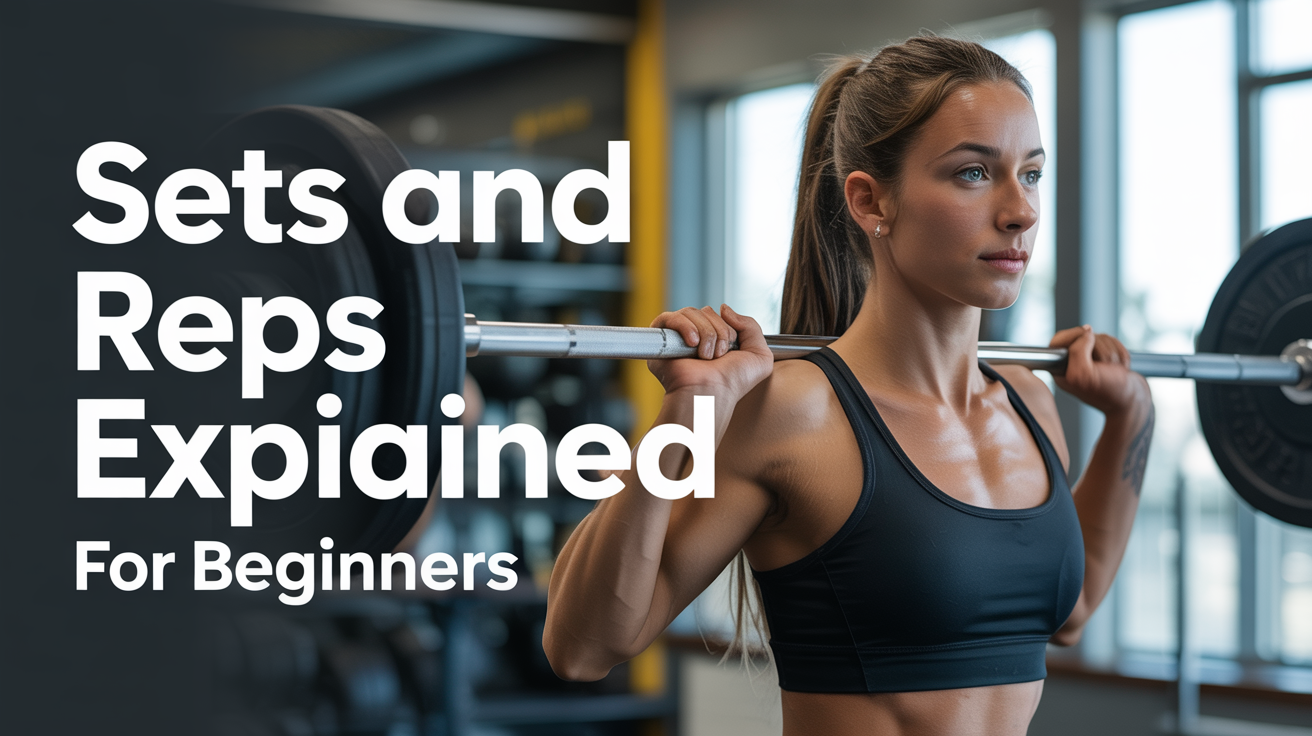
A rep (short for repetition) is one complete movement of an exercise. A set is a group of reps performed back-to-back without stopping. So "3 sets of 10 reps" means you do 10 squats, rest, do 10 more, rest, then do 10 again. That's the whole framework.
Everything else in this guide builds on that foundation. By the end, you'll know which rep ranges to use and why, how many sets to do per week, and what a sensible beginner program actually looks like on paper.
At a Glance
- A rep is one full movement; a set is a group of reps done without stopping. "3x10" means 3 sets of 10 reps.
- Most beginners should spend most of their training in the 6-15 rep range, often narrowed to 8-12.
- Rest 2-3 minutes for compound lifts (squat, deadlift, press) and 60-90 seconds for isolation work.
- Aim for roughly 10-15 sets per major muscle group per week, spread across 2-3 sessions; this comfortably clears the national guideline of muscle-strengthening work on at least 2 days a week.
- Train with 2-3 reps in reserve (RIR), not to failure, for nearly all of your first year.
- Default beginner prescription: 3 sets of 8-12 reps, stopping 2-3 reps short of failure, 2-3 minutes rest.
What Reps and Sets Actually Mean
Reps
A rep starts and ends in the same position. For a dumbbell curl, that's arm extended at the bottom, curl up, then lower back down to full extension. Both parts of the movement count as one rep. Most people rush the lowering phase (the eccentric), which is a mistake since it's where a lot of the muscle-building stimulus comes from. A controlled tempo, roughly two seconds up and two seconds down, is a good default.
Sets
A set is a bout of continuous work. You pick up the weights, do your reps, and put the weights down. That's one set. Sets give structure to your workout and let you track exactly what you did from session to session.
When you see a program written as "3x10" or "3 sets x 10 reps," those are interchangeable. Some programs also write it as "10, 10, 10" with rest intervals listed separately.
Rest Periods
Rest is the time between sets. It's not optional or wasted time. Your muscles need it to partially recover so the next set is actually productive. Skipping rest or cutting it short just means the second and third sets will be significantly weaker, which reduces the training stimulus.
A general guide:
- Compound movements (squat, deadlift, press): 2-3 minutes
- Isolation exercises (curls, tricep pushdowns): 60-90 seconds
If you're still breathing hard when the timer goes off, wait another 30 seconds. Rest periods are guidelines, not strict rules. A useful check: if your reps drop by more than 2-3 compared to your previous set at the same weight, you probably cut the rest short.
Rep Ranges and What They Train

This is where beginners often get confused. The internet is full of conflicting advice about "the best" rep range. The truth is that multiple ranges work, and they emphasize slightly different training outcomes.
| Goal | Rep Range | Load (% of max) | Rest Between Sets |
|---|---|---|---|
| Strength | 1-5 | 85-95% | 3-5 minutes |
| Muscle size (hypertrophy) | 6-15 | 65-80% | 90-180 seconds |
| Muscular endurance | 15-30 | 40-60% | 30-60 seconds |
The middle range (6-15 reps, often narrowed to 8-12 for beginners) is where most new lifters should spend their time. The loads are heavy enough to build real strength and muscle, but not so heavy that technique breaks down before you've developed the movement patterns.
Higher rep ranges (15-30) are useful for warming up, practicing technique, or certain accessory exercises, but they shouldn't be the main event for someone trying to build a base of strength.
Lower rep ranges (1-5) are effective but demand clean technique under heavy load. That combination is risky early on. Most beginners don't yet have consistent enough movement patterns to train heavy singles and triples safely, and technique breakdown under load is a recurring theme in how exercise injuries happen, whether from poor form, too much weight, or ramping intensity too quickly. See the 5 basic strength movements every beginner should learn for a primer on building those patterns first.
A Note on Load
"How heavy?" is the most common beginner question. The answer is that the load should make the target rep range challenging, not impossible. If you're aiming for 10 reps and you could easily do 20, the weight is too light. If you fail at rep 6, it's too heavy. You want a weight that gets genuinely hard in the last 2-3 reps without breaking form.
See how much weight a beginner should lift for a practical method to find your starting load.
How Many Sets Per Week (Volume Matters More Than Per-Session Sets)
Total weekly sets per muscle group is the number that actually drives growth over time. Per-session set counts matter less than people think.
A dose-response analysis of 15 resistance training studies found that each additional set per week produced a further, measurable increase in muscle growth, with roughly a 0.37 percent gain per extra set within the ranges studied and no clear ceiling. Beginners sit at the lower end of that range and still get strong, because their nervous systems are adapting rapidly. Doing 20 hard sets per week as a beginner isn't better; it's usually just harder to recover from.
A practical beginner target: 10-15 sets per major muscle group per week, spread across 2-3 sessions. That schedule also comfortably clears the national guideline calling for muscle-strengthening activity on at least 2 days a week, the widely cited baseline for adult strength training frequency.
That might look like:
- Squat pattern: 3 sets x 3 sessions = 9 sets (close enough)
- Push pattern (bench, overhead press): 3-4 sets x 2-3 sessions = 9-12 sets
- Pull pattern (row, pull-down): 3-4 sets x 2-3 sessions = 9-12 sets
- Hip hinge (deadlift, Romanian deadlift): 2-3 sets x 2 sessions = 4-6 sets
Hinges tend to need fewer sets because they're systemically taxing. Shoulders and arms get stimulus from the big push/pull movements, so they need little direct work.
Set Volume by Experience Level
Weekly set targets aren't fixed forever. As your recovery capacity improves over months and years, the productive range shifts upward.
| Experience | Sets per Muscle Group per Week | Why |
|---|---|---|
| Beginner (0-6 months) | 8-12 | Nervous system adapts fast; more volume adds fatigue without added benefit |
| Novice (6-18 months) | 10-15 | Recovery capacity improves; some muscle groups can handle more |
| Intermediate (18+ months) | 12-20 | Adaptations slow down; more volume is often needed to keep progressing |
Reps in Reserve: Why You Shouldn't Train to Failure
"Reps in reserve" (RIR) describes how many more reps you could have done before reaching failure. Training with 2-3 RIR means you stop the set when you have 2-3 reps still in you.
For beginners, this is the right approach. Here's why.
Training to absolute failure is hard to recover from, especially on compound movements. A true max-effort set of squats takes more out of you than most people realize. Beginners also don't yet have a reliable sense of where failure actually is, so chasing it often leads to form breakdown before the muscles are actually exhausted, and technique breakdown under fatigue is one of the more consistently cited contributors to exercise-related strains and overuse injuries.
Stopping 2-3 reps short keeps the technique clean, reduces injury risk, and still provides plenty of stimulus for growth. As you advance and your technique becomes automatic, you can push closer to failure on isolation exercises (like curls or leg extensions) while still staying away from it on big compounds.
A practical way to calibrate: after your last rep, ask yourself "could I have done 2-3 more with good form?" If the answer is no, the set was too hard. If you could have done 5+ more, go a little heavier next session.
RIR Quick Reference
| RIR (Reps in Reserve) | What It Feels Like | Use For |
|---|---|---|
| 4-5 | Comfortable, could do several more | Warm-up sets, technique practice |
| 2-3 | Challenging, form still solid | Most working sets for beginners |
| 0-1 | Very hard, form starting to slip | Occasional isolation work once experienced |
| 0 (failure) | Cannot complete another rep | Rarely needed; avoid on compounds as a beginner |
This connects directly to progressive overload, the mechanism by which you get stronger over time. Consistently training close to (but not at) failure while gradually adding load or reps is the core of any effective program.
A Simple Beginner Prescription
All of the above collapses into a simple starting point:
3 sets of 8-12 reps per exercise, stopping 2-3 reps before failure, with 2-3 minutes rest between sets.
Choose 3-5 exercises per session covering the main movement patterns (squat, hinge, push, pull), train 3 days per week, and aim for 10-15 total sets per muscle group across the week.
As you get comfortable with the movements over 4-6 weeks, start adding weight when you consistently hit the top of your rep range (12 reps) with good form. That's the whole system in its early form.
An example lower-body session might look like:
- Goblet squat: 3 x 10
- Romanian deadlift: 3 x 10
- Step-up: 3 x 10 per leg
- Leg curl (machine): 2 x 12
Total sets for the session: 11. Total weekly sets for quads and hamstrings across two such sessions: roughly 22, but many exercises overlap, so the effective muscle stimulus is distributed across the week.
Don't overcomplicate the early months. Consistency with a simple structure beats a "perfect" program done sporadically.
Frequently Asked Questions
Is 3 sets of 10 enough to build muscle?
Yes, for beginners it's plenty. Three sets of 10 with a challenging load, done consistently 2-3 times per week for each muscle group, produces real muscle and strength gains. Most beginners make their best progress in the first 6-12 months on exactly this structure.
Should I do more reps or more weight to get stronger?
Both matter, but in sequence. Start by adding reps within your target range (say, from 8 to 12). Once you can do all your sets at the top of the range with good form, add a small amount of weight (2.5 to 5 lbs on upper body exercises, 5 to 10 lbs on lower body) and start the rep range again from the bottom. This is called double progression, and it's one of the most reliable methods for beginners.
How many reps should I do per set to lose fat?
Rep ranges don't directly drive fat loss. Calorie balance does. That said, moderate rep ranges (8-15) with relatively short rest periods (60-90 seconds) increase the metabolic demand of a session, which can help. Trying to train in very high rep ranges (20-30) to "burn fat" often just means lifting light weights, which provides a weaker stimulus for maintaining muscle. Keep the weight meaningful and let your nutrition handle the fat loss.
What if I can't complete all my reps on every set?
That's normal, especially on later sets. If you hit 10, 9, and 8 reps across three sets, that's fine. Note what happened and try to match or beat it next session. What you want to avoid is a large drop-off: if your first set was 10 reps and your third was 4, the weight is too heavy or your rest is too short.
How long until I see results?
Strength gains typically show up within 2-4 weeks, driven largely by neural adaptations (your brain gets better at recruiting the muscles). Visible muscle changes take longer, usually 8-12 weeks of consistent training. The timeline depends on consistency, nutrition, sleep, and starting fitness level. Progress isn't linear, but it compounds.
Is it better to do fewer sets with more weight, or more sets with less weight?
For a beginner building a foundation, moderate weight for moderate sets (the 8-12 rep, 3-set default) beats either extreme. Very heavy, low-rep training demands technique you likely haven't built yet. Very light, high-rep training takes far more sets to produce the same stimulus, which eats into recovery and session time without a clear advantage. Once your form is solid, you can lean toward either end depending on your goal.
Do supersets or dropsets count as extra sets toward my weekly total?
Yes, generally. If you superset two exercises for the same muscle group, each working set of each exercise counts toward that muscle's weekly total. A dropset (continuing past your first "failure" point at a lighter weight) usually counts as most of an additional set, since it still adds meaningful fatigue and stimulus. Both are intensity techniques worth introducing after your first few months, not something a beginner needs from day one.