Mobility & Recovery
Mobility Exercises for Stiff Hips and Shoulders
A beginner's guide to hip and shoulder mobility exercises that reduce stiffness, improve squat and press depth, and keep joints moving well.
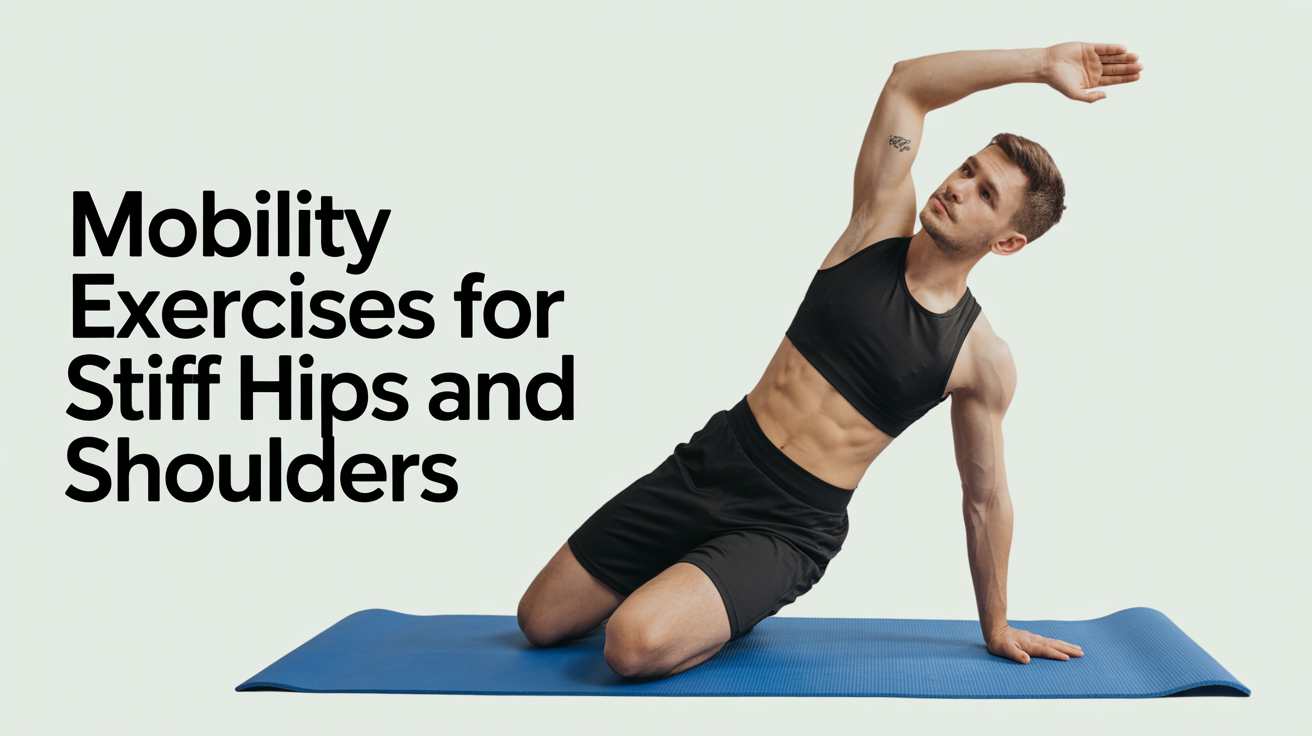
Stiff hips and tight shoulders are the two most common complaints beginners bring to the gym. They limit how low you can squat, how well you can press overhead, and how comfortable you feel sitting at a desk for eight hours. The good news: mobility is trainable. Ten to fifteen minutes of consistent daily work produces real, measurable improvements over weeks. You don't need to be naturally flexible, and you don't need to force anything.
This guide walks through the key drills for both joints, explains why they matter for your lifts, and tells you exactly how often to do them.
Why Hip and Shoulder Mobility Matter for Beginners
Your hips are the engine behind squats, deadlifts, and lunges. When hip flexors and external rotators are stiff, the hips can't fully extend or rotate, so your lower back compensates. That's how beginners end up with a rounding lower back at the bottom of a squat, not because their technique is wrong, but because their hips physically can't reach the required range without pulling elsewhere.
Your shoulders govern every pressing and pulling movement. Limited shoulder flexion cuts your overhead press short. Poor thoracic (mid-back) mobility forces the lumbar spine to hyperextend to make up the difference. Tight lats pull the shoulders forward, which compresses the front of the joint under load.
Fixing these two areas doesn't just make you more comfortable. It directly improves lift mechanics, reduces injury risk, and lets you train harder with less compensatory strain.
Hip Mobility Exercises for Beginners
Work through these in sequence. Move to the edge of your comfortable range, breathe, and let the position open up. Never push into sharp or stabbing pain.
90/90 Hip Stretch
This drill targets hip internal and external rotation simultaneously, two ranges that most beginners lack.
- Sit on the floor with both legs bent at 90 degrees: front shin parallel to the top of your mat, back shin running behind you.
- Sit tall, not slumped. Both sitting bones should be close to the floor.
- Hold the position and breathe for 60–90 seconds, then switch sides.
- To progress, hinge forward over your front shin, keeping your back flat.
The 90/90 is the single most useful hip drill for squat mechanics. It builds the rotational range you need to track your knees over your toes without your hip crashing inward.
Hip Flexor Stretch (Kneeling Lunge)
Long hours of sitting shorten the hip flexors (psoas, rectus femoris). Short hip flexors pull the pelvis forward and flatten or overarch the lower back.
- Kneel on one knee, the other foot forward in a lunge position.
- Squeeze the glute of the back leg and gently push the hips forward until you feel a stretch at the front of the back hip.
- Keep your torso upright, don't lean forward.
- Hold 45–60 seconds per side.
The glute squeeze is the important part. It posteriorly tilts the pelvis and deepens the stretch without requiring you to push aggressively.
Deep Squat Hold
This is both a mobility drill and a diagnostic. If you can hold a deep squat for 60 seconds with your heels flat and your chest up, your squat mobility is in a workable place.
- Stand with feet slightly wider than hip-width, toes turned out 15–30 degrees.
- Lower into a full squat, elbows pressing gently against your inner knees.
- Hold your chest up and breathe.
- If your heels lift, stand on a small plate or rolled yoga mat until you can lower them over time.
Start with 20–30 seconds and build toward 60 over two to three weeks.
World's Greatest Stretch
The name is earned. It addresses hip flexors, thoracic rotation, and hamstrings in one flowing movement.
- From a lunge position, place your same-side hand on the floor inside your front foot.
- Rotate your opposite arm up toward the ceiling, following it with your eyes.
- Lower that arm, then windshield-wiper your front foot out to the side for a hamstring component.
- Return to standing and repeat on the other side.
- Do 5 slow reps per side.
Pair this with a proper warm-up before any session. It bridges mobility work into movement prep.
Shoulder Mobility Exercises for Beginners
The shoulder is the most mobile joint in the body, which also makes it the most prone to restriction from poor posture and desk work. These drills restore the range you need for pressing and pulling.
Wall Slides
Wall slides retrain shoulder blade movement (scapular upward rotation) and lengthen the muscles that pull the shoulders forward.
- Stand with your back against a wall, feet a few inches out from the baseboard.
- Press your lower back, upper back, and the backs of your hands against the wall.
- Slide your arms up the wall into a Y shape, keeping contact the whole way.
- Slowly lower back down.
- Do 10–12 reps.
If you can't keep your hands on the wall through the full range, go only as high as you can while maintaining contact. The contact is the point.
Band Dislocates (or Dowel Dislocates)
This drill takes the shoulder through its full circumduction range. Use a resistance band (easier) or a PVC pipe or broomstick.
- Hold the band or stick with a wide grip, arms straight, palms down.
- Raise it overhead and continue the arc behind you until it touches your hips.
- Reverse back to the start.
- Do 10 slow reps.
Wider grip = easier. Narrow it gradually as your range improves over weeks. If you feel impingement or sharp pain at any point, widen your grip immediately.
Thoracic Rotations
The thoracic spine (mid-back) is meant to rotate. When it's stiff, the lumbar spine and shoulders compensate. This drill restores that rotation directly.
- Lie on your side, knees stacked and bent at 90 degrees, arms extended forward at shoulder height.
- Keep your knees together and pressed into the floor.
- Take your top arm and rotate it slowly across to the opposite side, following with your gaze.
- Return to the start.
- Do 8–10 reps per side.
The knees-together constraint prevents the hips from just rolling over, which is cheating. The rotation should happen above the hips.
How Often to Do These Drills
Mobility responds to frequency more than volume. A 10-minute session done six days a week produces better results than a 60-minute session once a week.
Practical starting point:
- Do the full sequence (all seven drills) before every strength training session as a warm-up.
- On rest days, do 5–10 minutes of whichever drill is your tightest area.
- Rest days have real purpose. Use them for light mobility work rather than skipping movement entirely.
Most beginners notice meaningful change within three to four weeks of consistent daily work.
Drill Reference Table
| Drill | Primary Target | Reps / Hold |
|---|---|---|
| 90/90 Hip Stretch | Hip internal/external rotation | 60–90 sec per side |
| Hip Flexor Stretch | Hip flexors, psoas | 45–60 sec per side |
| Deep Squat Hold | Hip flexion, ankle dorsiflexion | 30–60 sec |
| World's Greatest Stretch | Hip flexors, thoracic rotation, hamstrings | 5 reps per side |
| Wall Slides | Scapular upward rotation | 10–12 reps |
| Band Dislocates | Shoulder circumduction | 10 reps |
| Thoracic Rotations | Thoracic spine rotation | 8–10 reps per side |
Frequently Asked Questions
How long until I notice my hips and shoulders feeling less stiff?
Most beginners feel an improvement in a single session (a temporary reduction in stiffness from increased blood flow and tissue warmth). Lasting structural change, where your resting range expands and you don't tighten back up overnight, typically takes three to six weeks of consistent daily work. The timeline varies based on how restricted you are at the start and how consistently you practice.
Should I stretch before or after lifting?
For these mobility drills, before lifting is ideal. Dynamic movements like the world's greatest stretch and wall slides prepare joints without reducing force output the way prolonged static holds can. Post-training is a good time for longer static holds (60–90 seconds) if your muscles are already warm. If soreness is slowing you down between sessions, targeted post-training stretching helps with recovery.
Will better hip mobility actually improve my squat?
Yes, directly. Hip flexor length affects how far you can hinge at the hip before your pelvis tucks under (the "butt wink"). External rotation range determines whether your knees can track over your toes. Both of these limit squat depth and technique. Improving them through consistent drilling produces measurable changes in how low you can squat with a neutral spine within a few weeks.
What if one side is much stiffer than the other?
Asymmetry is normal. Always perform the drill bilaterally but spend an extra round on the stiffer side. Over time, the sides should converge. Persistent asymmetry after several weeks, or asymmetry accompanied by pain, is worth a conversation with a physiotherapist or sports medicine doctor.
When should I stop and see a professional?
Stop the drill immediately if you feel sharp, shooting, or joint-level pain (as opposed to the typical mild discomfort of a tight muscle being stretched). Numbness, tingling, or radiating pain in the arm or leg are also signals to pause. See a physiotherapist if a restriction doesn't improve after four to six weeks of consistent work, or if it's limiting basic daily activities. Mobility training is appropriate for normal tightness, not for structural problems.